






 Trap
 Normal
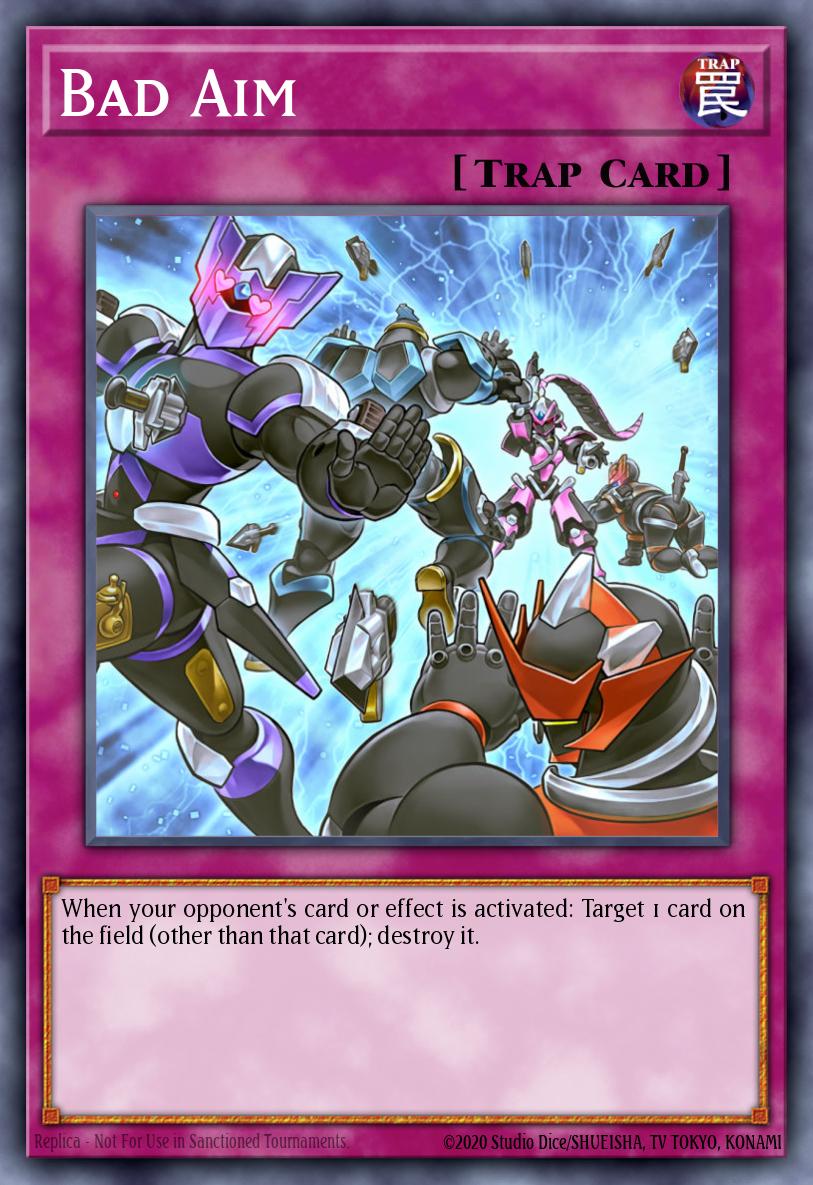
Bad Aim
View:
3912
When your opponent's card or effect is activated: Target 1 card on the field (other than that card); destroy it.
Bad Aim — Power Evaluation
Final Score: 54 ± 8 · Confidence: Medium
- Intrinsic: 55 · Deck: 53 · Meta: provisional
- Primary role: Removal
Why it scores here
Bad Aim turns one opponent activation into a one-for-one destruction of any other card on the field, so it scores as a flexible reactive removal trap. It has no card advantage, combo starter, or material value, and the text gives it no way to build a board. Its score comes from interaction flexibility and a cheap, light deck slot seen across 22 archetypes; the 55-deck sample supports accessibility and portability but does not raise the power score, and the absence of any recorded combo appearance caps conversion and the Deck score.
Axis scores
| Axis | Score | Evidence |
|---|---|---|
| Accessibility | 55 | Set Normal Trap with no searcher or draw route in the evidence; 1.62 average copies across 55 decks gives it a reasonable chance to be in the backrow when needed (observed). |
| Combo & Conversion | 30 | No recorded combo boards (total combos 0); the text is a single destruction on activation, so it converts into one board removal and nothing further (verified). |
| Resource Economy | 45 | The trap is spent to destroy one card, a one-for-one trade, with no search, draw, or graveyard refuel in the text (verified). |
| Effect & Interaction | 55 | Destroys any other field card in response to an opponent activation; flexible targeting, but it requires the opponent to activate something first and cannot hit the activated card itself (verified). |
| Material Utility | 5 | Spell/Trap cards have no material or level role, so this axis is near zero (verified). |
| Resilience & Flexibility | 35 | A Normal Trap can be stopped by a counter trap or negation and has no recursion; redundancy comes only from copies held, and the evidence has no counter data (inferred). |
| Deck-Building Efficiency | 70 | Generic single-slot trap with no garnet or lock; 27 of 55 decks run 1 copy and 22 run 2, so slot cost is light (observed). |
Calculation
Weight profile: Removal / Negation profile (primary role only, no secondary blend). Intrinsic ≈ 55, Deck ≈ 53, Meta = provisional. Modifiers: none. Final formula: 0.40*Intrinsic + 0.60*Deck
Strengths
- Destroys any other field card in response to an opponent activation, so it answers both monsters and backrow
- Cheap, generic, single-slot trap with light copy cost and no garnet or lock
- Consistently played across 22 archetypes in the 55-deck sample (observed, not a power signal on its own)
Weaknesses
- Reactive: does nothing unless the opponent activates a card or effect first
- One-for-one trade with no card advantage or recursion
- Cannot destroy the card that activated it, and a Normal Trap cannot be used on the turn it is set (inferred from card type)
- No recorded combo appearances, so no evidence of board conversion
Counters / choke points
- Opponent avoids activating into the trap, which is the main play-around (inferred)
- Counter traps or negations stop the activation (inferred from general rules; no counter data in evidence)
Best use
Single-slot reactive removal for on-field threats in trap-slot builds. Decks: Elemental Heros, Shiranui, Ritual Beasts. Suggested copies: 1.
Evidence & gaps
- Verified: Card text: destroy one other target card on the field when the opponent's card or effect activates; Card type is Trap (Normal); 55 decks run it at 1.62 average copies; No combo appearances recorded
- Observed: Copy distribution: 27 decks run 1, 22 run 2, 6 run 3; Co-occurs in 27 decks with Paleozoic Canadia and Book of Moon; Spread across 22 archetypes and 3 gameplay types
- Inferred: Set-then-activate timing for a Normal Trap; Play-around by not activating into it; Counter traps stop it, from general rules
- Data gaps: no combos supplied: combo conversion is text-only inference no usage statistics (StatisticsCard): archetype inclusion % inferred from deck sample only no banlist token: legal copies empty, assumed 3 copies guide snippets do not name Bad Aim by card id in the featured sections, so guide support is absent format ids (3, 7, 4) are unnamed in the evidence no counter or negation data for the card